
Manual tracking (spreadsheets, shared drives, email threads) breaks down fast under that load. Compliance management software closes the gap by centralizing policy enforcement, automating evidence collection, and keeping your organization audit-ready year-round instead of scrambling before every review.
This guide compares ten leading platforms, from broad enterprise GRC suites to specialized tools built for a single regulatory niche, plus what to weigh before you commit budget and implementation time.
TL;DR
- Compliance software automates evidence collection, control monitoring, and audit prep for continuous audit-readiness
- The right fit depends on organization size, regulated industry, framework scope, and integration needs
- This roundup covers 10 platforms: enterprise GRC suites, automation-first tools, and niche picks like FileVision
- Weigh control library depth, automation workflows, framework mapping, and reporting before you buy
Overview of Compliance Management Software in Today's Regulatory Landscape
Compliance management software automates the operational grind behind staying compliant: collecting evidence, monitoring controls, managing policies, and maintaining audit trails that used to live in binders and inboxes.
The category is growing fast because the regulatory burden keeps expanding. The US enterprise GRC market was valued at $4.92 billion in 2024 and is projected to reach $8.88 billion by 2029, a 12.5% CAGR. Growth is driven largely by organizations layering new frameworks on top of existing ones.

Most platforms on this list serve broad, cross-industry needs: SOC 2, ISO 27001, GDPR, HIPAA. But some sectors don't fit neatly into generic GRC:
- Healthcare providers answer to HHS-OIG guidance
- Financial institutions face layered federal and state oversight
- Public housing agencies must track SEMAP scoring under CFR 985 and file HUD-52648 certifications
These are requirements no general-purpose GRC tool was built to handle.
That's why this list spans two categories: general-purpose platforms built for broad framework coverage, and specialized tools built for one regulatory environment where accuracy and speed matter more than breadth.
Top 10 Compliance Management Software Solutions
We selected these platforms based on framework coverage, automation depth, integration ecosystem, scalability, and verified user reviews. For sector-specific tools, we also weighed regulatory accuracy against the governing body for that industry.
Optro (formerly AuditBoard)
AuditBoard rebranded to Optro in March 2026, but the core positioning hasn't changed: a connected risk platform unifying compliance, audit, and risk management in one place. It supports somewhere between 30 and 40+ frameworks depending on which product page you check, including SOC 2, ISO 27001, and DORA.
Its standout feature is AI-powered cross-framework mapping paired with continuous control monitoring, which matters most for organizations running multiple frameworks in parallel and tired of duplicating evidence for each one.
| Category | Details |
|---|---|
| Key Features | AI-powered multi-framework mapping, automated evidence collection, continuous control monitoring, 200+ integrations |
| Best For | Mid-market to enterprise teams managing multiple compliance frameworks |
| Reviews/Notes | 4.6/5 on G2 across more than 1,600 reviews |
Vanta
Vanta built its reputation on continuous monitoring for cloud-first companies chasing SOC 2 or ISO 27001 certification. The platform runs 1,400+ automated hourly tests across 400+ integrations, with controls pre-mapped to more than 35 frameworks.
For startups without a dedicated compliance hire, that volume of automated testing does the heavy lifting manual setup would otherwise require. Vanta holds a 4.6/5 rating on G2 across nearly 2,000 reviews, one of the highest review counts on this list.
| Category | Details |
|---|---|
| Key Features | 1,400+ automated tests, 400+ integrations, pre-mapped controls across 35+ frameworks |
| Best For | Cloud-first startups and SaaS companies pursuing SOC 2 or ISO 27001 |
| Reviews/Notes | 4.6/5 on G2 (1,938 reviews) |
Drata
Drata takes a similar always-on approach to technical control monitoring, with particular strength in AWS and other cloud-native environments. Evidence collection pulls automatically from dev tooling, and controls are reusable across frameworks instead of rebuilt every time you add a new one.
Reviewers consistently point to setup speed as a top advantage for engineering-heavy teams.
| Category | Details |
|---|---|
| Key Features | Always-on monitoring, automated evidence collection, reusable controls across frameworks |
| Best For | Cloud-native teams wanting continuous technical control monitoring |
| Reviews/Notes | 4.7/5 on G2 (1,333 reviews) |
ServiceNow GRC
ServiceNow GRC lives inside the broader Now Platform, so compliance workflows connect directly to ITSM and SecOps data already flowing through the system. That's the appeal: large enterprises already standardized on ServiceNow get unified risk and compliance operations without bolting on a separate tool.
It's a harder sell for organizations not already invested in the ecosystem, given the platform's enterprise-level complexity.
| Category | Details |
|---|---|
| Key Features | Automated control testing, integrated risk scoring, third-party risk modules |
| Best For | Large enterprises standardized on the ServiceNow ecosystem |
| Reviews/Notes | 4.2/5 on G2 (108 reviews) |
RSA Archer
Archer, formerly RSA Archer, has been a fixture in financial services and government compliance for years. It centralizes policy tracking and workflow automation at a scale few competitors match, with a public-sector solution built specifically for government risk, compliance, and continuity needs.
The tradeoff is a steeper learning curve and implementation timeline than newer, automation-first tools.
| Category | Details |
|---|---|
| Key Features | Policy tracking, automated workflows, risk and audit management tools |
| Best For | Large enterprises and government agencies needing a scalable compliance platform |
| Reviews/Notes | 3.6/5 on G2 (20 reviews) |
SAP GRC
SAP GRC makes the most sense for organizations already running SAP infrastructure. It handles continuous monitoring of risks, identities, and compliance status, plus fraud detection through access-risk anomaly detection built natively into the platform.
Outside the SAP ecosystem, there's little reason to choose it over more flexible standalone tools.
| Category | Details |
|---|---|
| Key Features | Automated risk monitoring, fraud detection, access-risk anomaly detection |
| Best For | Enterprises running SAP systems that need embedded compliance tracking |
| Reviews/Notes | 4.2/5 on G2, SAP Risk Management module (81 reviews) |
MetricStream
MetricStream targets heavily regulated, multi-jurisdictional enterprises, particularly in banking and insurance. Its Intelligent Content Libraries feed in regulatory updates, sanctions lists, and cyber ratings, while newer AI-powered features extend into risk, compliance, audit, and regulatory change tracking.
It's built for organizations with a dedicated GRC function, not lean compliance teams.
| Category | Details |
|---|---|
| Key Features | Regulatory content libraries, automated control assessments, multi-entity dashboards |
| Best For | Highly regulated, multi-jurisdictional enterprises with dedicated GRC functions |
| Reviews/Notes | 3.5/5 on Capterra, MetricStream CyberGRC (small sample size) |
OneTrust
OneTrust leads the privacy compliance category, built around GDPR, CCPA, and data protection obligations. Its Privacy Impact Assessment automation and Regulatory Intelligence feature, which monitors global laws and regulator guidance, make it the default choice for privacy-first compliance teams.
It's narrower than the enterprise GRC suites on this list, but that focus is the point.
| Category | Details |
|---|---|
| Key Features | Automated privacy assessments, data mapping, incident response management |
| Best For | Organizations prioritizing data privacy compliance across jurisdictions |
| Reviews/Notes | 4.3/5 on G2, Privacy Automation module (154 reviews) |
LogicGate Risk Cloud
LogicGate's Risk Cloud is a no-code GRC platform, meaning compliance teams can build and adjust workflows themselves instead of waiting on developer resources. Its Spark AI feature now recommends record linking across GRC elements, speeding up cross-framework mapping.
That flexibility suits teams whose processes evolve faster than a rigid platform can keep pace with.
| Category | Details |
|---|---|
| Key Features | No-code workflow builder, Spark AI record-linking recommendations, real-time dashboards |
| Best For | Teams needing configurable, workflow-centric GRC without dedicated development resources |
| Reviews/Notes | 4.6/5 on G2 (191 reviews) |
FileVision (Specialized for Housing Authorities & Public Sector Compliance)
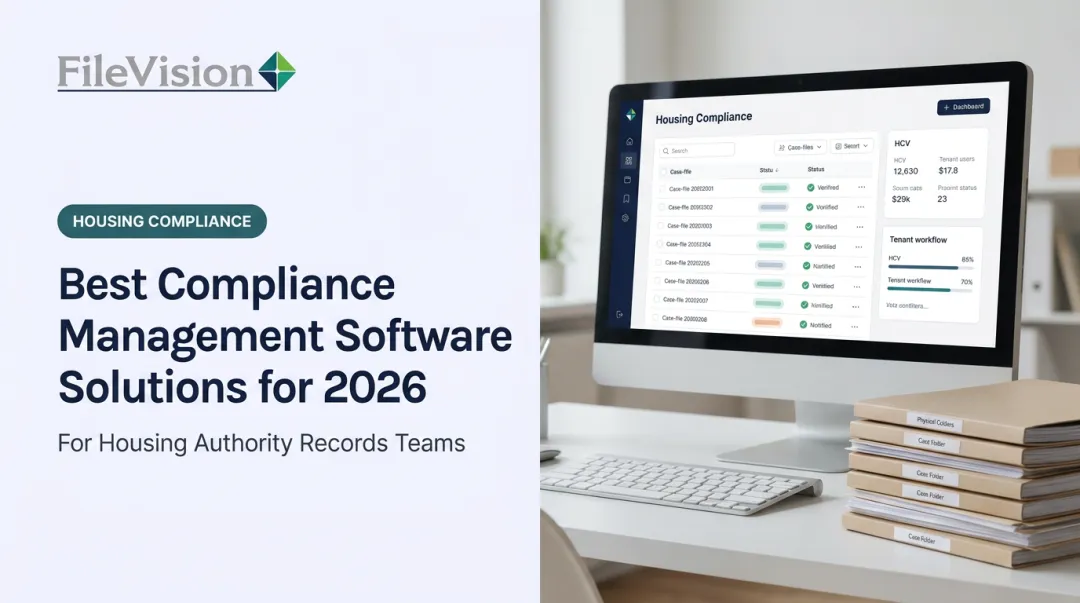
Every platform above is built for broad, cross-industry compliance. FileVision takes the opposite approach: it's a purpose-built document and tenant records platform for housing authorities and community development agencies, built around HUD's specific certification requirements rather than a generic control library adapted after the fact.
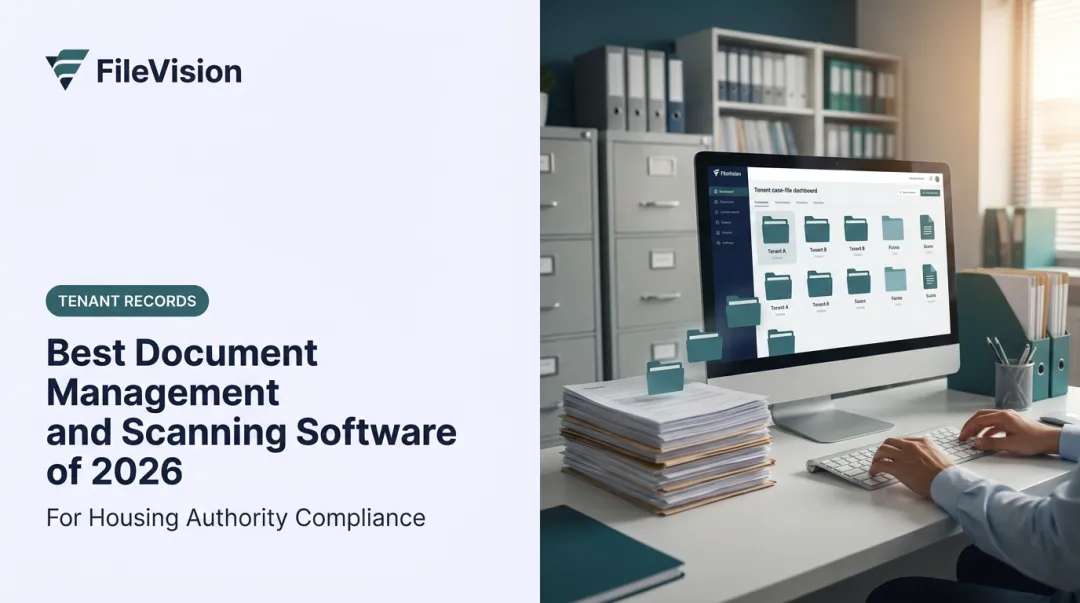
The standout is its Electronic Tenant Records (ETR) platform, which routes HCV, public housing, and PBV/RAD documents through HUD-specific workflows. NSPIRE inspection evidence and grievance case files live in the same system, backed by direct HMS integration for real-time accuracy. Generic GRC tools don't have this depth of housing-specific workflow. They weren't designed for it.
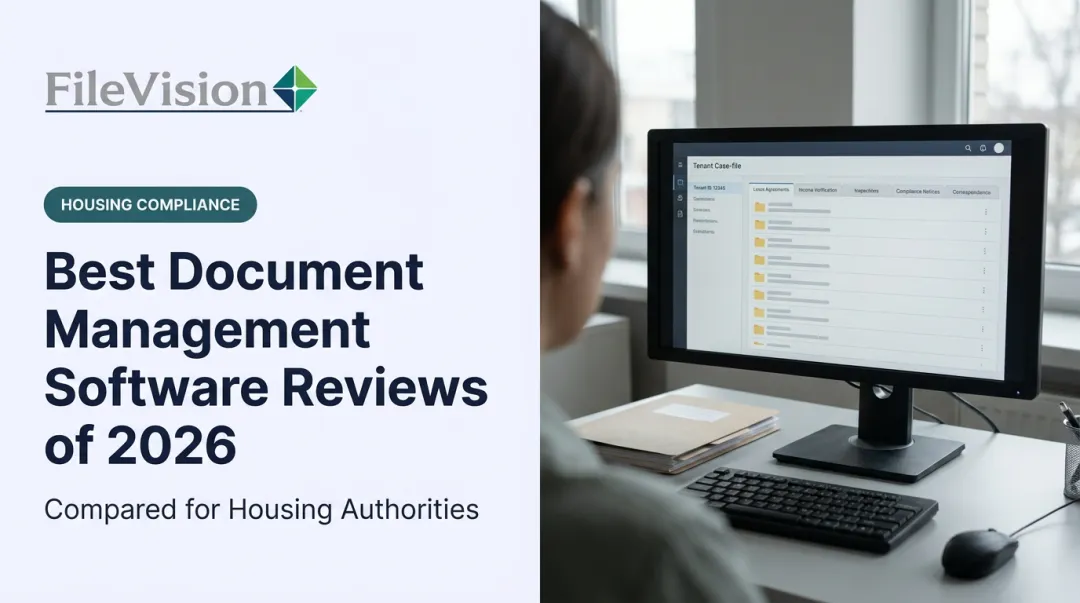
FileVision's transaction-based system links every document directly to the process it belongs to: Intake, Annual Recertification, or Interim Change. The checklist tells staff what's missing, not just what's on file, and external auditors get secure, role-based read-only access so reviews happen remotely instead of requiring an on-site visit.
Housing authority customers have used FileVision since 2012, with self-reported productivity gains ranging up to 25% organization-wide and 34% in specific departments. A VP of HCV at a Southeastern housing authority reported generating audit and accounts reports in under five minutes, a task that used to take considerably longer with paper files.
| Category | Details |
|---|---|
| Key Features | HCV & public housing workflows, NSPIRE inspection evidence, direct HMS integration, role-based auditor access |
| Best For | Public Housing Agencies and community development agencies needing HUD-specific tenant records and compliance workflows |
| Reviews/Notes | Customer relationships dating to 2012, with documented productivity gains of up to 34% in specific departments |

Key Features to Look for in Compliance Management Software
Not every platform above will fit your organization. Here's what actually matters when comparing options.
A Control Library That Maps Across Frameworks
Look for a control library deep enough to map requirements across multiple frameworks at once. Strong platforms include:
- Clear ownership assigned to every control, not buried in a spreadsheet
- Testing schedules attached automatically so reviews don't slip
- Control reuse across overlapping frameworks, so one piece of evidence for SOC 2 also satisfies ISO 27001
Without this, teams end up managing frameworks in silos, duplicating work every time a new regulation applies.
Evidence Workflows and Audit Trails
The best platforms pull evidence automatically through integrations rather than relying on manual uploads. Look for:
- Scoped, read-only access for auditors instead of full system access
- Timestamped trails logging who did what, when, and why
- Direct system integrations that remove manual evidence collection
Automation and Continuous Monitoring
Static, point-in-time compliance checks miss drift between audits. Continuous controls monitoring means technology-enabled, high-frequency automated checks that validate control effectiveness in near real time. As regulatory scope expands, that automation is what keeps manual follow-up from spiraling.
Sector-specific compliance doesn't always map cleanly onto generic frameworks, though. HUD's CFR 985 scoring, for example, has no equivalent in a standard SOC 2 or ISO 27001 control library. Organizations facing that gap typically need a purpose-built tool with the regulatory mapping already done, the way FileVision's SEMAP module auto-calculates CFR 985 scores for housing authorities rather than adapting a generic platform.
How We Chose the Best Compliance Management Software
The most common mistake we see: picking a platform based on brand name alone, without checking whether it actually maps to your frameworks or matches how your team wants to own controls day-to-day.
A recognizable enterprise GRC brand can still be the wrong fit if your team is three people managing SOC 2, not a dedicated compliance department.
We weighed five factors for every platform on this list:
- Framework and industry coverage: does it support the specific regulations you're tracking, not just a generic list
- Automation depth: how much evidence collection and control testing happens without manual intervention
- Integration ecosystem: whether it connects to the tools where your evidence already lives
- Customer reviews: verified feedback from G2, Capterra, and similar platforms, weighted by review volume
- Scalability: whether the platform grows with your framework scope and headcount

These criteria matter most when your compliance needs are highly specialized. For regulated, sector-specific organizations like public housing agencies, purpose-built tools consistently outperformed generic GRC platforms on regulatory accuracy and reporting speed.
FileVision's SEMAP scoring and HUD-52648 generation are a clear example: no general-purpose platform on this list replicates that out of the box.
Conclusion
There's no single "best" compliance management software here. The right pick depends on your framework mix, how your team wants to own controls, and whether you're operating in a sector with its own regulatory body to answer to.
Before committing, pilot your shortlist against real requirements. Confirm each platform on:
- Framework coverage: how it handles your specific frameworks, not just the ones in the demo
- Implementation support: onboarding, training, and data migration included
- True cost: pricing at your actual user count and module mix, not just the sticker price
That evaluation matters most for specialized sectors. If you're running a public housing agency or community development agency and need HUD-specific compliance tracking (SEMAP scoring, HUD-52648 generation, tenant record audit trails), a generic GRC suite likely won't get you there. FileVision's purpose-built platform was designed to close that gap.
Frequently Asked Questions
What is compliance management software?
Compliance management software automates the workflows behind achieving and maintaining regulatory compliance, including evidence collection, control monitoring, and reporting. It replaces manual spreadsheets and shared drives with a centralized, audit-ready system.
What are the 7 pillars of compliance?
According to HHS-OIG guidance, the seven pillars are written policies, compliance oversight, training, effective communication, enforcement and incentives, risk assessment and monitoring, and corrective action. Most frameworks map back to some version of these.
What's the difference between compliance management software and GRC software?
Compliance software focuses narrowly on tracking and automating adherence to specific regulations. GRC software integrates broader governance and enterprise risk management alongside compliance, covering more organizational ground.
How much does compliance management software typically cost?
Pricing varies widely by vendor, framework scope, and organization size. Some platforms price per module, others per user count. Request quotes based on your specific frameworks rather than comparing sticker prices alone.
How long does it take to implement compliance management software?
Automation-first tools can onboard in a matter of weeks, with some vendors citing a 30-to-90-day rollout. Enterprise GRC suites typically take longer, often several months, depending on integration complexity and framework scope.
Is generic compliance software suitable for regulated public sector agencies like housing authorities?
Generic GRC platforms often lack built-in HUD/CFR-specific scoring and forms, like SEMAP calculations or HUD-52648 generation. Purpose-built tools such as FileVision handle that regulatory niche more efficiently than adapting a general-purpose platform.