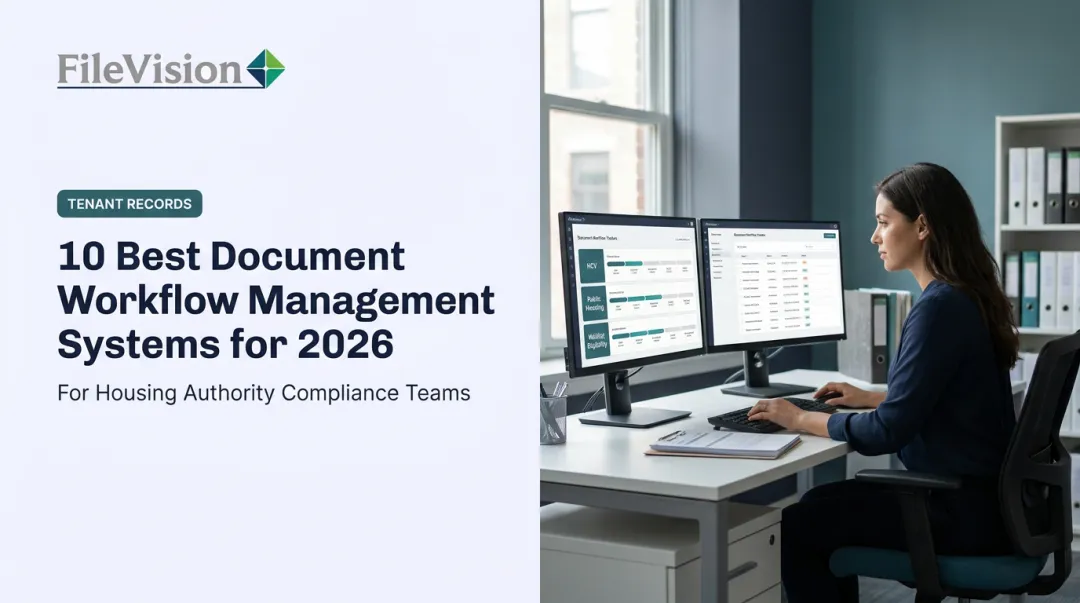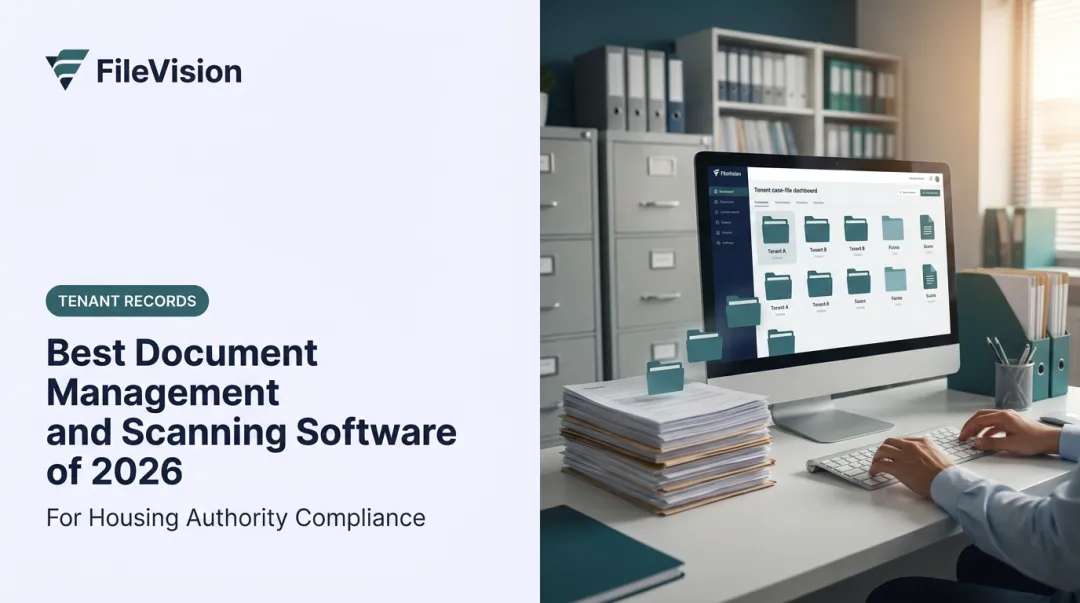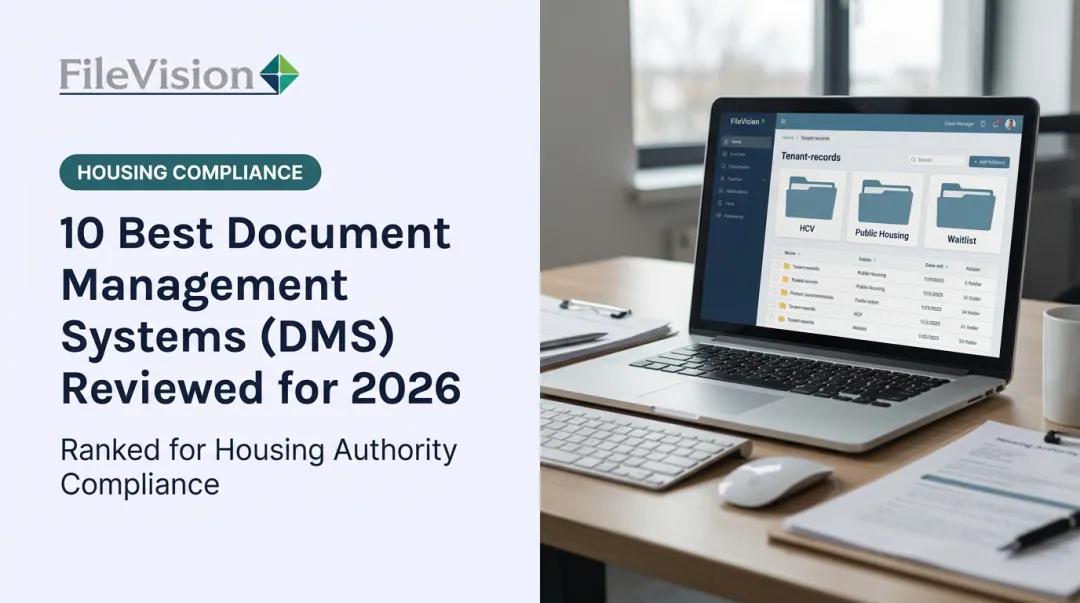

Gartner estimates that 70%-90% of enterprise data is unstructured as of its May 2026 update, meaning most organizations are managing a growing mountain of files without a reliable system tracking who changed what, when, and why. That's a real risk for compliance-heavy sectors where an outdated draft or duplicate file can trigger a failed audit.
This guide reviews the 10 best document version control software options in 2026, covering their key features, pricing, and ideal use cases so you can choose with confidence.
TL;DR
- Version control software tracks every revision and approval, creating a single audit trail
- The right tool depends on your industry, compliance needs (HUD, GDPR), team size, and integrations
- This list includes general platforms like Google Workspace and SharePoint, plus specialized tools like FileVision
- Selection criteria include audit trail depth, access controls, workflow automation, integrations, and total cost
Overview of Document Version Control Software in 2026
Document version control software automatically tracks revisions, timestamps, authorship, and approval status, so teams always work from the correct, current file. It replaces manual habits like "Final_v2" naming with systems that log every edit and let you roll back mistakes instantly.
The push toward these tools goes beyond convenience. Remote and hybrid work, tighter regulatory scrutiny, and broader digital transformation efforts are forcing organizations to abandon manual file tracking entirely.
Housing authorities feel this pressure acutely. HUD requires public housing agencies to retain executed leases, HAP contracts, and at least three years of HUD-50058 forms and supporting documentation for active participants. Manual folders simply don't hold up under that kind of scrutiny, and compliance needs like these vary widely across industries.
The software below spans three categories:
- General collaboration platforms built for everyday teams
- Enterprise content management systems designed for large, complex organizations
- Industry-specific solutions purpose-built for regulated sectors like housing

Top 10 Best Document Version Control Software in 2026
This list was curated based on audit trail capability, ease of collaboration, integration options, security, and value across different organization sizes and industries.
1. FileVision
FileVision is a transaction-based document and records management system purpose-built for housing authorities, community development agencies, and other compliance-driven organizations. Rather than organizing files by document type, it links version-controlled records directly to key workflows: Intake, Annual Recertification, and Interim Changes.
What sets it apart:
- Direct HMS integration pulls tenant data in real time, cutting down on double entry and data errors
- SEMAP module auto-fills the HUD-52648 certification form using CFR 985 scoring
- Role-based, read-only access lets external auditors review specific tenant records remotely, without an on-site visit
- Established housing authority track record, with documented client relationships dating back to at least 2012
| Key Features | Transaction-linked versioning, Electronic Tenant Records (ETR), audit-ready role-based access, centralized Noticeboard and Dashboard for oversight |
| Pricing | Custom quotes based on organization size and modules needed; contact FileVision for details |
| Best For | Housing authorities, PHAs, and community development agencies needing compliance-focused version control |
2. DocuWare
DocuWare is a cloud-based document management and workflow platform used across industries for automated indexing, audit logging, and version tracking. It logs every editor, change, and timestamp, and lets teams compare or restore prior versions on demand.
Its standout strength is SOP-driven version numbering paired with conflict resolution when two people edit simultaneously, plus solid Microsoft 365 integration.
| Key Features | Automated version numbering, exportable audit logs, workflow-triggered approvals |
| Pricing | Roughly $13-$76 per user/month (about £10-£60) for DocuWare Cloud, sold annually |
| Best For | Mid-size to large enterprises needing workflow-integrated version control |
3. M-Files
M-Files takes a metadata-driven approach to document management, meaning version control doesn't depend on rigid folder structures. Files are tagged and organized by what they are, not where they're stored.
AI-powered classification automatically applies metadata, while permission-based version access and retention policies support regulated industries.
| Key Features | Metadata-based versioning, AI content classification, automated retention policies |
| Pricing | Essentials starts at $65 per seat/month; Enterprise uses custom pricing |
| Best For | Enterprises seeking metadata-first document organization and compliance |
4. Adobe Acrobat / Document Cloud
Adobe Acrobat is the go-to tool for teams already living in PDFs. It offers version tracking, commenting, and rollback for individual files, plus a genuinely useful Compare Files tool that flags text, formatting, and image differences between two versions.
It isn't designed for repository-style version control at scale, but contract-heavy teams often find it covers everything they need.
| Key Features | Version comparison, rollback to prior versions, cloud-saved file history |
| Pricing | Standard at $14.99/license/month; Pro at $23.99/license/month (annual commitment) |
| Best For | Teams primarily managing PDF-based contracts and documents |
5. Microsoft SharePoint & OneDrive
SharePoint and OneDrive come bundled into Microsoft 365 and offer automatic version history for shared and individual files. Version limits are configurable at the organization, site, or library level, with a default cap of 500 major versions and no expiration.
Its biggest edge is enterprise-wide familiarity. Most staff already know how to use it, which shortens rollout time considerably.
| Key Features | Automatic version history, real-time co-authoring, configurable retention |
| Pricing | Business Basic around $6-7/user/month; Standard $12.50; Premium $22 (billed yearly) |
| Best For | Organizations already standardized on Microsoft 365 |
6. Google Workspace
Google Workspace (Drive, Docs) offers real-time revision history for every file, letting users name specific versions and restore them with one click. Uploaded non-Google files get separate version management, though older versions may be deleted after 30 days or 100 newer versions unless marked "Keep forever."
Simplicity is the appeal here. There's almost no learning curve.
| Key Features | Real-time revision history, named versions, one-click restore |
| Pricing | Business Starter around $7-8.40/user/month; Standard $14-16.80; Plus $22-26.40, depending on billing plan |
| Best For | SMEs and teams prioritizing simplicity and real-time collaboration |
7. Box
Box is an enterprise content management platform with granular version history and permissions. Version retention scales by tier: 25 versions on Starter, 50 on Business plans, 100 on Enterprise, and unlimited with Governance enabled.
Its compliance credentials, including SOC 1/2/3 and HIPAA support, make it a common choice for organizations handling sensitive external sharing.
| Key Features | Tiered version history retention, granular permissions, e-signature integration |
| Pricing | Business at $20/user/month annually; Business Plus $33; Enterprise $47 (3-user minimum) |
| Best For | Enterprises needing secure external collaboration with strict access controls |
8. Dropbox Business
Dropbox Business offers extended version history and file recovery, with a 180-day recovery window on Standard and a full 365 days on Advanced. Smart Sync and file locking round out its collaboration toolkit.
It's a strong fit for teams working heavily with outside partners who need dependable sync without a steep learning curve.
| Key Features | Extended version recovery window, smart sync, file locking |
| Pricing | Standard at $15/user/month; Advanced $24/user/month (annual billing, 3-user minimum) |
| Best For | Distributed teams and external collaborators needing reliable file sync |
9. Doxis (SER Group)
Doxis combines version control with workflow automation, AI-powered classification, and deep SAP integration. Every draft becomes "Version 1," recording author, timestamp, metadata, and workflow status, with each subsequent edit forming a traceable chain tied to review and approval.
It's SAP-certified for document management, making it a natural fit for organizations already running SAP ERP or S/4HANA.
| Key Features | Workflow-driven versioning, audit-proof archiving, SAP/ERP integration |
| Pricing | Quote-based depending on modules and deployment; request a demo for specifics |
| Best For | Large enterprises needing version control tied to complex business processes |
10. Confluence
Confluence handles version control at the page level rather than the file level, which makes sense given its role as a team knowledge base. Page history supports viewing, comparing, and restoring earlier versions, and it integrates tightly with Jira for linking documentation to active work.
It's lightweight by design, which is exactly why software teams love it for internal documentation.
| Key Features | Page version history, inline comments, macro-based templates |
| Pricing | Free for up to 10 users; Standard $5.42/user/month; Premium $10.44/user/month |
| Best For | Software teams and internal knowledge bases needing lightweight documentation version control |
How We Chose the Best Document Version Control Software
We weighed five factors: audit trail depth, access controls, workflow and approval automation, integration flexibility, and cost relative to organization size.
A common mistake we see: choosing a tool based on brand recognition rather than compliance fit. A well-known productivity suite might handle version history fine but lack the audit reporting depth a regulated sector actually needs.
Industry-specific requirements matter more than most buyers realize:
- HUD compliance for housing authorities managing tenant records
- ISO 9001 documented information controls for manufacturers, requiring availability, protection, and retention safeguards per ISO's clause 7.5 guidance
- HIPAA retention rules for healthcare organizations

Matching software capabilities to these compliance frameworks, not just feature checklists, is what separates a good fit from a costly mismatch.
Conclusion
The right document version control software should align with your operational goals and compliance requirements, not just popularity or sticker price. A tool that works beautifully for a marketing team may fall apart under a HUD audit.
Before committing, evaluate:
- Scalability: will it grow with your team and file volume?
- Integration: does it connect with your existing HMS, ERP, or CRM systems?
- Total cost of ownership: including training, migration, and any per-module add-ons
Organizations with heavy compliance and tenant records management needs, such as housing authorities, may find that generic productivity suites leave gaps. FileVision's purpose-built ETR platform was designed specifically to close those gaps with consistent, audit-ready version control.
Frequently Asked Questions
What is the best tool for document version control?
It depends on your use case. General businesses often do fine with Google Workspace or Microsoft 365, while regulated industries like housing authorities benefit more from purpose-built systems like FileVision.
What is document version control software?
It's software that tracks document revisions, authorship, and approval history, ensuring teams always work from the current, correct file rather than an outdated draft.
What features should I look for in a document version control system?
Look for strong audit trails, granular access permissions, workflow automation, and integration capability with the systems you already use, like your HMS or ERP platform.
Is document version control the same as document management?
No. Version control is one feature within broader document management systems, which also handle search, archiving, and compliance tools across an organization's entire file library.
How does document version control improve compliance?
It creates an audit trail proving exactly who changed what and when, which directly supports regulatory reviews, HUD audits, and third-party certifications.
Which document version control software is best for regulated industries like housing authorities?
FileVision stands out here, with compliance modules such as SEMAP for HUD-52648 certifications built specifically for HUD-regulated housing authorities, unlike generic productivity tools.