
Many organizations still track compliance with spreadsheets, shared drives, and email reminders. That approach breaks down fast, leading to missed deadlines, failed audits, and expensive penalties. Ponemon research found that organizations facing non-compliance issues spend an average of $14.82 million annually, compared to $5.47 million for those that stay compliant, per Fortra's cost-of-compliance study.
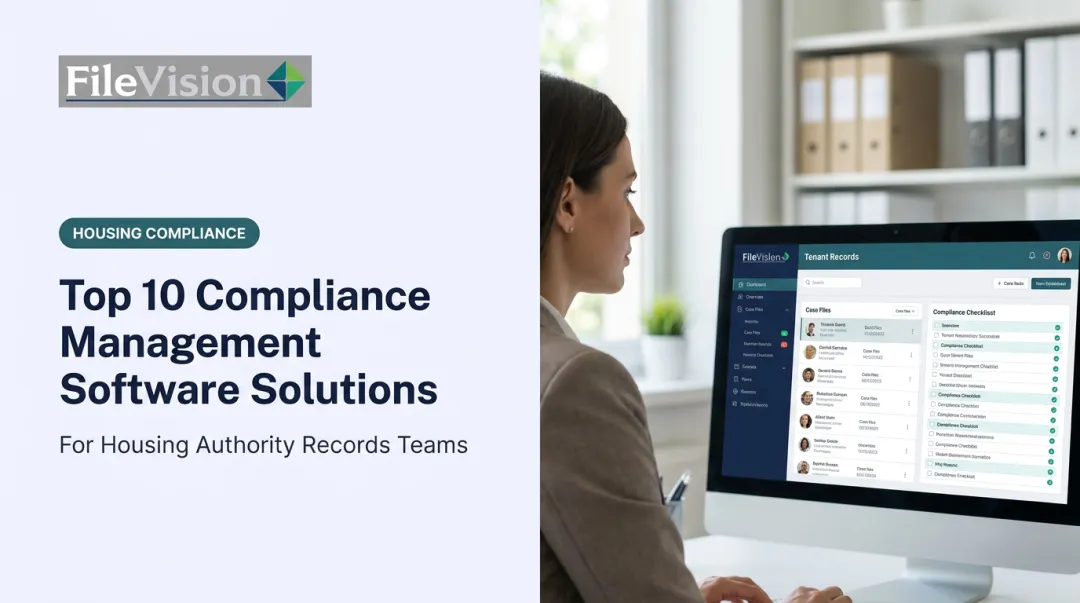
This guide reviews the top compliance management platforms for 2026 — from general GRC and cybersecurity tools to specialized solutions like housing authority compliance software.
TL;DR
- Compliance software centralizes policy tracking and automates audits, reducing regulatory risk across industries.
- There's no single "best" tool — it depends on whether your needs are operational, GRC-focused, or industry-specific.
- Base your choice on framework coverage, automation depth, and integrations, not brand recognition alone.
- This roundup covers five standout platforms, including one built specifically for public housing agencies.
Overview of the Compliance Management Software Market in 2026
Compliance management software centralizes how organizations track regulatory obligations, document evidence, and prove adherence to auditors. It has moved well past the once-a-year audit scramble. Today, compliance is a continuous, embedded function that runs alongside daily operations rather than a fire drill every twelve months.
The numbers reflect that shift. The global enterprise compliance market is on track to nearly double by 2030, climbing to $7.11 billion at a 14.2% CAGR, according to recent market research. Vendors are racing to keep pace with that demand.
The category itself has fragmented into distinct lanes:
- GRC platforms — enterprise-wide governance, risk, and compliance oversight
- Operational/field compliance tools — no-code systems connecting frontline work to back-office records
- Industry-specific solutions — purpose-built for healthcare, financial services, or public housing
Picking the wrong lane is the most common mistake buyers make. A generic GRC tool won't handle HUD certification math any better than a housing-specific platform will manage SOC 2 evidence collection. Below, we break down five platforms that each dominate a different lane.
Top Compliance Management Software Solutions for 2026
Each platform below was evaluated on four factors: industry specialization, automation and framework coverage, integration depth, and verified customer trust.
FileVision
FileVision is a global software solution provider headquartered in Atlanta, with offices across Europe, the Middle East, and Australasia.
Since 2012, its housing authority customers have progressively moved away from fully manual, paper-based processes toward electronic tenant records (ETR). The company has built its platform specifically around HUD compliance and community development agency workflows.
What sets FileVision apart is specificity. Its SEMAP module auto-calculates scores per 24 CFR Part 985 for every performance indicator and auto-generates the official HUD-52648 certification form, pulling directly from certification selections rather than requiring manual transcription.
Pair that with direct HMS integration, which pulls tenant names, rent data, recertification dates, and household details in real time. The result is a system where duplicate data entry and transcription errors simply don't happen.
| Category | Details |
|---|---|
| Best For | Public Housing Agencies (PHAs), housing authorities, and community development agencies managing HUD compliance |
| Key Features | SEMAP auto-scoring, HUD-52648 generation, role-based external auditor access, centralized Noticeboard/Dashboard, transaction-linked document management |
| Support & Guarantee | Monday–Saturday live support (9am–8pm), 100% guarantee, 1-year warranty on the accredited document management system |
A VP of HCV at a Southeastern housing authority reported generating audit and account reports in just 5 minutes using FileVision, a task that once meant pulling and scanning paper files. That's the kind of gain generic tools adapted for public housing rarely deliver, since they weren't built around HUD's regulatory logic in the first place.

Vanta
Vanta built its reputation as a compliance automation platform for startups and scaling SaaS companies chasing certifications like SOC 2 and ISO 27001. Instead of manually gathering screenshots and logs before an audit, teams connect their systems and let Vanta collect evidence continuously.
The platform supports 35+ compliance frameworks and monitors them automatically once integrations are live [8]. Its Trust Center feature lets companies showcase real-time compliance status to prospects and customers, turning security posture into a sales asset rather than a back-office chore.
| Category | Details |
|---|---|
| Best For | Startups and SaaS companies seeking fast, automated security certifications |
| Key Features | Automated evidence collection, 35+ framework support, risk management, questionnaire automation |
| Limitation | Less suited for complex, multi-framework enterprise GRC or field-based operational compliance needs |
One G2 reviewer noted that audit prep work which used to take 1-2 weeks now takes a couple of hours with Vanta's automated evidence pulling [7]. That's a strong signal for lean teams, though it doesn't translate well to organizations juggling dozens of overlapping regulatory frameworks.
OneTrust
OneTrust operates at a different scale entirely. It's an integrated GRC platform built for large, global organizations managing privacy and data regulations across multiple jurisdictions. Where smaller compliance tools focus on a handful of frameworks, OneTrust is designed to handle the mess of overlapping global requirements.
Its standout feature is the proprietary Shared Evidence Framework, which lets compliance teams collect evidence once and apply it across 50+ global frameworks [5]. Rather than re-proving the same control for GDPR, then again for a separate regulation, teams document it once and reuse it.
| Category | Details |
|---|---|
| Best For | Large enterprises managing multiple global privacy and regulatory frameworks |
| Key Features | Shared Evidence Framework, AI governance tools, automated privacy impact assessments, third-party risk management |
| Limitation | Steep learning curve and higher cost, making it less practical for smaller organizations |
A Forrester Total Economic Impact study modeled a composite enterprise customer paying roughly $292,000 annually in platform fees [16], a figure that illustrates OneTrust's enterprise positioning rather than a universal price tag. G2 data shows nearly half of its reviewers come from enterprise-tier organizations, reinforcing that this isn't a tool most small teams need.
AuditBoard
AuditBoard is a connected audit, risk, and compliance platform aimed at enterprises managing SOX requirements, internal audits, and ESG reporting. Instead of exporting spreadsheets for every control review, teams work inside a unified system that tracks issues and evidence in one place.
The platform's AuditBoard AI feature generates control narratives and flowcharts automatically, mapping risks to controls without manual documentation [10]. An independent 2026 platform review also credits AuditBoard with 200+ third-party integrations, though that count doesn't currently appear on the vendor's own integration page [13].
| Category | Details |
|---|---|
| Best For | Large, regulated enterprises needing unified audit, risk, and compliance oversight |
| Key Features | AuditBoard AI, automated issue tracking, 200+ integrations, real-time dashboards |
| Limitation | Can become expensive as users and modules scale; steep learning curve for advanced features |
AuditBoard makes the most sense for organizations already running formal internal audit functions. Smaller teams without a dedicated audit department will likely find the module count overwhelming for what they actually need.
Quickbase
Quickbase takes a different approach altogether: a flexible, no-code operations platform that lets teams build custom compliance workflows around their actual operations, not a pre-built template. That flexibility matters most for organizations with field-connected work, including construction crews, manufacturing floors, and field service technicians, where compliance data originates far from a desk.
The platform's biggest differentiator is genuine field-to-office connectivity. Offline mobile data collection through its FastField integration lets crews log inspections and compliance checks without signal, syncing automatically once connected [4]. Layered on top is Smart Governance, an AI-powered feature that generates audit trails automatically as work happens [20].
| Category | Details |
|---|---|
| Best For | Organizations with complex, industry-specific operational compliance needs connecting field data to back-office systems |
| Key Features | Custom workflow builder, offline mobile data capture, AI-powered Smart Governance, enterprise-grade audit trails |
| Limitation | Requires upfront configuration time; not ideal for teams needing only a simple e-signature or document tool |
If your compliance risk lives mostly on paper in an office, Quickbase is overkill. If it lives on a jobsite, it's one of the few tools built to close that gap properly.
How We Chose the Best Compliance Management Software
The most common buyer mistake is picking a generic GRC platform without checking whether it supports your industry's specific framework or integrates with your existing systems, let alone offers mobile capability. A tool can look impressive in a demo and still fail your first real audit if it doesn't map to your regulatory environment.
We ranked each platform on:
- Regulatory/framework coverage — Does it support the specific standards you're audited against, tied directly to audit readiness?
- Automation and AI capability — How much manual evidence-gathering does it eliminate?
- Integration ecosystem — Does it connect to the systems (HMS, ERP, CRM) that already hold your data?
- Industry specialization — Is it purpose-built for your sector, or a generic tool with your terminology bolted on?
- Verified customer feedback — Do real users confirm the vendor's claims hold up in practice?
Each factor ties directly to a business outcome: less time prepping for audits and fewer errors from duplicate data entry. The real test comes when a regulator or examiner shows up unannounced — a platform that never mapped to your framework has nowhere to hide.
Conclusion
Brand recognition alone won't tell you which compliance platform is right for your organization. What matters is finding software that matches your specific regulatory environment and day-to-day operational reality. A SaaS startup chasing SOC 2 needs something entirely different from a housing authority managing HUD certifications or a construction firm tracking field inspections.
That distinction matters just as much once you start evaluating platforms directly. Look at scalability, integration requirements, and total cost of ownership over a multi-year horizon, not just the first-year quote.
Housing authorities and community development agencies evaluating HUD-specific compliance tools can explore FileVision's ETR platform, built specifically around HUD recordkeeping requirements and the everyday realities of public housing administration.
Frequently Asked Questions
What is the best compliance software?
There's no universal "best" option. The right platform depends on whether your need is GRC, operational, or industry-specific — FileVision for housing authorities, Vanta for SaaS security certifications, and so on.
What is compliance software?
Compliance software centralizes policy tracking and automates regulatory workflows, giving teams a clear view of where they stand against industry standards. It replaces manual spreadsheet tracking with automated alerts and audit trails that capture evidence in real time.
What are the 4 types of compliance?
Common categories include regulatory rules set by government agencies, industry-specific standards such as HUD or HIPAA, internal policies like a company's code of conduct, and legal or contractual obligations tied to vendor and partner agreements.
What is the difference between GRC and compliance management software?
GRC platforms take a broad, enterprise-wide view spanning governance, risk, and compliance together. Compliance management software takes a narrower approach, tracking specific regulatory deadlines and organizing the evidence tied to each task.
How much does compliance management software typically cost?
Pricing varies widely. Entry-level plans can start around $20/month, while advanced subscriptions often run $400/month or more, according to Capterra's compliance software guide. Enterprise platforms typically require a custom quote.
Do small organizations need compliance management software?
Yes, once manual tracking becomes error-prone or regulatory exposure grows. Even small teams benefit from automated deadline tracking and centralized evidence once spreadsheets can't keep pace with growing compliance demands.