
Get it wrong, and the consequences aren't limited to a bad tenant relationship. HUD can suspend a landlord's ability to accept vouchers entirely or refer owners and agents to its Departmental Enforcement Center for serious or repeated violations.
This guide breaks down the core compliance pillars every landlord, PHA, and management agent needs to master: fair housing obligations, HQS/NSPIRE inspections, leasing and rent rules, recordkeeping, and the pitfalls that show up most often in HUD audits.
Key Takeaways
- Source-of-income and voucher-acceptance rules vary by state and city — verify local law first.
- HQS/NSPIRE inspections are an ongoing obligation, not a one-time hurdle before lease-up.
- Every Section 8 lease requires the HUD Tenancy Addendum, with rent tied to PHA-approved reasonableness standards.
- Incomplete tenant files and missed recertifications rank among the most common HUD compliance findings.
- Documentation systems and staff training remain the strongest defense against fines, abatement, or program termination.
Fair Housing Act & Anti-Discrimination Compliance
The Fair Housing Act protects tenants from discrimination based on race, color, national origin, religion, sex, familial status, and disability. Here's the part landlords frequently get wrong: source of income is not a federally protected class. Refusing a voucher holder isn't automatically illegal under federal law — it depends entirely on where the property sits.
State and local rules diverge sharply:
- Michigan: Public Act 178 of 2024 bars covered landlords from rejecting an otherwise-eligible tenant based on lawful income source, including Housing Choice Vouchers, effective April 2, 2025. Landlords who own five or fewer rental units total are exempt.
- Florida: The statewide fair housing statute doesn't include source of income as a protected category. Miami-Dade County is the exception, prohibiting voucher discrimination under its own county code.
- New York: State Human Rights Law has protected lawful income sources, including Section 8, since 2019. New York City reinforces this, and coverage applies regardless of building size in most cases.

Reasonable Accommodations and VAWA Protections
Unlike source-of-income rules, disability accommodations apply nationwide regardless of state law. Tenants with disabilities are entitled to reasonable accommodations (policy changes) and reasonable modifications (physical changes like ramps or grab bars). Service animals and emotional support animals count as accommodations rather than pets, so no pet fee applies and the animal doesn't need formal training.
Under the Violence Against Women Act, survivors of domestic violence, dating violence, sexual assault, or stalking cannot be denied housing or evicted because of that history. Landlords and PHAs must maintain emergency transfer procedures and protect survivor confidentiality.
Enforcement is real. In 2022, HUD required the Dallas Housing Authority to pay $500,000 to resolve a discrimination claim, alongside corrective action requirements. Fair housing complaints go through HUD's FHEO investigation process, and settlement amounts vary widely based on the violation.
Housing Quality Standards (HQS) & NSPIRE Inspection Compliance
A unit must pass inspection before a voucher holder can move in, and that's only the starting line. Inspections evaluate safety, utilities, structural integrity, and sanitation, and compliance is expected continuously, not just at lease-up.
The inspection cycle includes:
- Initial inspection before occupancy
- Periodic inspections, generally every one to two years
- Special or complaint-driven inspections triggered by reported conditions
Repair timelines are strict. Life-threatening deficiencies (gas leaks, exposed wiring, non-functioning smoke detectors) generally require correction within 24 hours. Other issues typically have a 30-day window, though a PHA may grant extensions in specific cases. Housing authorities that centralize inspection dates, repair deadlines, and NSPIRE evidence in a single digital record, such as FileVision's ETR platform, can meet these windows without scrambling through paper files.
What Happens After a Failed Inspection
Failing an inspection triggers direct financial consequences for owners:
- HAP payments may be withheld or abated until the deficiency is fixed
- Owners aren't entitled to retroactive payment for the abatement period
- Continued noncompliance can trigger HAP contract termination
- The family may be issued a voucher to move to another unit
One thing landlords should track closely: HUD's NSPIRE standard has a new compliance date for Housing Choice Voucher and Project-Based Voucher programs, now pushed to February 1, 2027. Until then, PHAs may continue using legacy HQS. NSPIRE organizes deficiencies by Unit, Inside, and Outside areas rather than the older HQS categories. Inspections remain pass/fail, not numerically scored, for HCV purposes.

Lease Agreements, Rent Compliance & Eviction Process
Lease Agreements and Rent Compliance
Every Section 8 lease must include the HUD Tenancy Addendum. It's not optional, and it controls over conflicting lease language: if your standard lease says one thing and the addendum says another, the addendum wins.
The addendum defines:
- Rent split between tenant and HAP subsidy
- Maintenance responsibilities
- Conditions under which the lease can be terminated
Rent itself has to align with HUD's Fair Market Rent guidelines, and the PHA must approve rent reasonableness before initial lease-up, before any rent increase, and whenever the FMR comparison flags a concern. Comparables come from unassisted units, weighing location, size, condition, and amenities.
One rule trips up more landlords than any other: collecting side payments from a voucher tenant is strictly prohibited. Charging anything beyond the PHA-approved rent, even for items "customarily included" in rent elsewhere in the market, violates the HAP contract outright.
Eviction and Termination Compliance
Landlords must notify the PHA when initiating an eviction, providing a copy of the notice at the same time it goes to the tenant. Federal rules require notification, not prior approval. The eviction reason, however, still has to satisfy both HUD's permitted grounds and state/local landlord-tenant law. Discriminatory or retaliatory evictions remain illegal regardless of voucher status.
If the property changes hands through foreclosure, the Protecting Tenants at Foreclosure Act generally entitles voucher tenants to at least 90 days' notice, and the new owner must honor the existing HAP contract — including executing the required transfer paperwork for subsidy payments to continue.
Recordkeeping, Documentation & Annual Recertification Compliance
Annual recertification is a hard, non-negotiable requirement under HUD rules. PHAs must re-verify income and household composition at least every 12 months, with documentation flowing into required program forms. Missed or incomplete recertifications consistently rank among HUD's most cited findings during compliance reviews.
Core documentation HUD expects owners and agents to maintain:
- Leases and Tenancy Addenda
- HAP contracts
- Inspection reports and evidence
- Rent ledgers
- Tenant-PHA communication logs and notices
- Income verification and recertification records
The real challenge is proving, on demand, that every file is complete and current. This is where paper-based systems tend to break down. A missing signature or a misfiled inspection photo can turn a routine audit into a corrective action plan.
Where SEMAP Fits In
SEMAP scoring under 24 CFR Part 985 evaluates PHAs across indicators like waiting list selection, rent reasonableness, income determinations, and inspection timeliness. Scores above 90% earn "High Performer" status; below 60% lands a PHA in "Troubled" territory, with corrective deadlines attached.
Accurate documentation feeds directly into this scoring, and into the HUD-52648 certification that reports it.
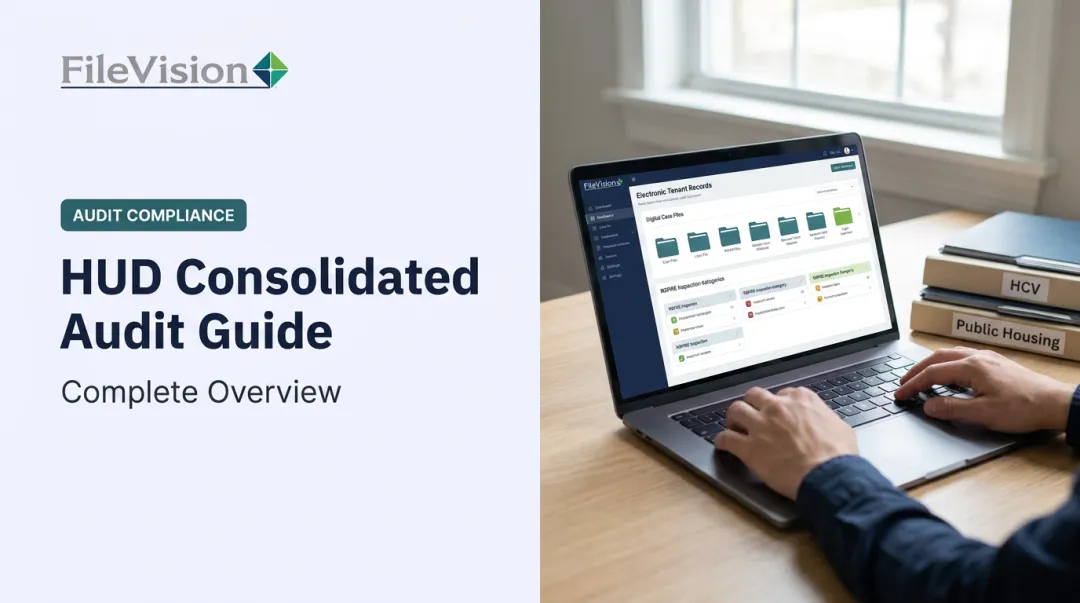
FileVision's Electronic Tenant Records (ETR) platform was built to close precisely this gap. Rather than filing documents by type or date, ETR organizes records by transaction: Intake, Annual Recertification, and Interim Changes. Every piece of paperwork tied to a specific housing event lives together in one place. Configurable checklists flag missing documents in real time, and the platform's Notice Board triggers alerts as recertification deadlines approach.
FileVision's SEMAP module takes this further. It auto-calculates indicator scores in accordance with 24 CFR 985 based on PHA responses and uploaded evidence, then auto-generates the HUD-52648 certification form directly from those selections. For external audits, role-based access lets auditors view only the specific tenant files relevant to their review, without exposure to unrelated or sensitive records like grievance files.

Housing authorities using the platform have reported productivity gains in the 25% to 34% range, largely tied to eliminating manual, paper-based recordkeeping. Fewer manual touches mean fewer chances for a file to go missing right before an audit.
Common Compliance Pitfalls, Penalties & Enforcement Actions
HUD compliance audits keep surfacing the same categories of trouble. The most frequent findings include:
- Unauthorized distributions from project accounts ("equity skimming")
- Underfunded tenant security deposit accounts
- Overpaid management fees
- Improper reserve withdrawals
Notably, HUD's Office of Inspector General has flagged that HUD could not produce a compliant improper-payment estimate for its rental assistance programs, including HCV, for eight consecutive years. This gap signals that eligibility, income, and payment controls deserve continued scrutiny at the property level.
The escalation path typically looks like this:
- HUD identifies a deficiency during audit or SEMAP review
- The PHA or owner receives a corrective action plan with a deadline
- Continued noncompliance triggers referral to HUD's Departmental Enforcement Center
- Serious or repeated violations can lead to civil monetary penalties or debarment from the program
Staying ahead of these findings comes down to a few practical habits:
- Train staff regularly on current HUD handbooks and policy updates
- Review internal compliance checklists quarterly to catch drift early
- Partner with compliance-focused software or consultants for larger portfolios, using tools that automatically flag certification and income-verification discrepancies before HUD does
Frequently Asked Questions
What is the fine for violations of Section 8?
Penalties vary widely by violation type and severity, ranging from corrective action requirements to civil monetary penalties or debarment for repeated offenses. Check HUD's current enforcement guidelines for specific dollar figures tied to your situation.
Do landlords have to accept Section 8 in Michigan?
As of April 2, 2025, covered Michigan landlords generally cannot reject an otherwise-eligible tenant based on lawful income source, including vouchers. Landlords owning five or fewer total rental units are exempt from this requirement.
What are the Section 8 requirements in Florida?
Florida's statewide statute doesn't require voucher acceptance, but Miami-Dade County prohibits source-of-income discrimination under its own ordinance. Standard federal HQS and inspection rules still apply statewide regardless of local voucher-acceptance laws.
What are the Section 8 rules in New York?
New York State law has prohibited source-of-income discrimination since 2019, covering Section 8 explicitly. New York City reinforces these protections, with coverage applying to most rental properties regardless of size.
How often must Section 8 rental units be inspected?
Units need an initial inspection before lease-up, followed by periodic inspections generally every one to two years. Special inspections can be triggered anytime by tenant complaints or reported deficiencies.
Can a landlord evict a Section 8 tenant without PHA approval?
Yes. Federal rules require PHA notification, not prior approval, to start an eviction. Landlords must still follow a permitted ground for termination and comply with state and local landlord-tenant law throughout the process.